MCP Server
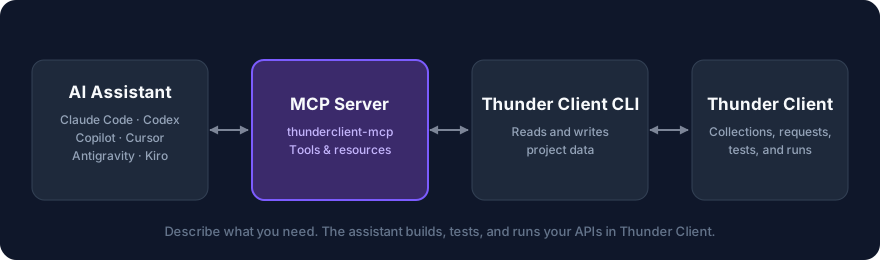
The Thunder Client MCP server is open source (GitHub ) and lets your AI assistant create, update, and run Thunder Client requests and collections from plain-language prompts. It works with Claude Code, Codex, GitHub Copilot, Cursor, Antigravity, Kiro, and any other MCP -compatible tool.
What You Can Do
Build CollectionsGenerate collections from your source code or an API spec.
Create and Edit RequestsCreate and update requests from a prompt, including from cURL commands.
Add TestsAdd tests and capture tokens into environment variables.
Run and FixRun requests and collections, fix failures, and generate reports.
Get Started
Requires Node.js 22 or later.
- Add the MCP server to your AI tool. For example, in Claude Code:
claude mcp add thunderclient -- npx -y thunderclient-mcp- Try a prompt such as “Create a collection from the routes in src/routes/”.
Changes appear immediately in the Thunder Client sidebar.
The Thunder Client CLI is installed automatically the first time the MCP server runs.
See Installation for Codex, Copilot, Cursor, Antigravity, Kiro and other tools.
Privacy
- No login or API key. The MCP server works without a Thunder Client login, account token, or API key — there’s nothing to configure beyond adding it to your AI tool.
- Runs on your machine. The server runs locally and reads and writes your project’s Thunder Client data on disk. It doesn’t send your requests or collections to Thunder Client servers.
- No analytics. The MCP server doesn’t collect analytics or track usage.
- Secrets stay private. The assistant never sees environment variable values or saved credentials.
- Responses are shared. The assistant sees response bodies from requests it runs, so avoid running requests that return data you don’t want to share.
- Open source. The code is MIT-licensed, so you can verify all of this on GitHub .
See What the Assistant Can See for details.
Next Steps
- Install the MCP server.
- Review the Available Tools.
- Try the Example Prompts.
Last updated on